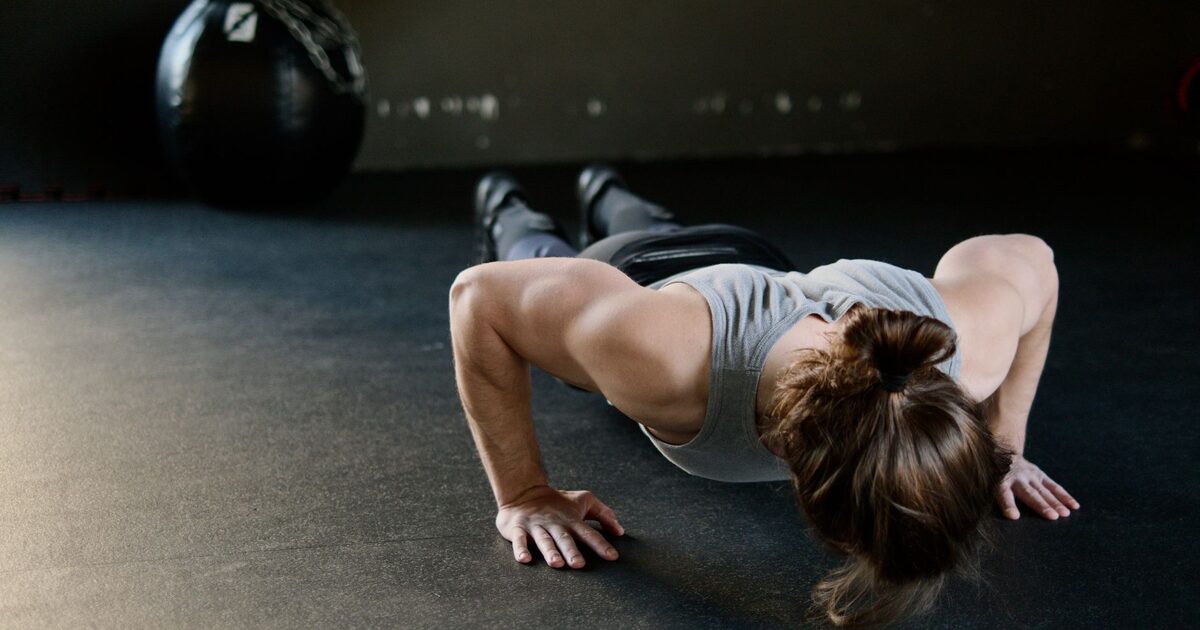
The push-up is the most honest exercise you own. No machine props you up and no momentum hides a weak spot — it's just your body, the floor, and whatever range of motion you've actually earned. But "do a push-up" spans from someone fighting to hold a 20-second plank to a gymnast pressing into a one-arm hold. Below are 12 variations ranked easiest to hardest, each with the form cue that separates a real rep from a sloppy one and a target that tells you when to move up.
Two rules for every rep
The order tracks how much bodyweight your arms move and how much stability the position demands. Two rules apply at every level:
- Squeeze a straight line. Ears, shoulders, hips, and ankles stack in one plank from start to finish. A sagging lower back or a hips-in-the-air pike trades chest work for a lumbar strain — if the line breaks, the set is over.
- Own the bottom. Lower under control for about 2 seconds until your chest is a fist's height off the floor, pause, then press. Bouncing off the floor cheats your chest out of the hardest part of the rep.
If you're unsure what a neutral spine feels like, build that base first — our guide on the plank and its variations covers the bracing you'll carry into every push-up here.
Beginner: building the pattern (1–4)
1. Wall push-up
Stand arm's length from a wall, hands at shoulder height and a little wider than your shoulders; bend the elbows to bring your chest to the wall, then press back. Nearly vertical, your arms move only 10–15% of your bodyweight, the lowest-load way to groove the pattern.
Move up when: 3 sets of 15 feel easy. Common mistake: standing too close so your elbows barely bend — step back for full range.
2. Incline push-up
Hands on a sturdy bench, table, or kitchen counter; body in a straight line on the balls of your feet. It trains the same line as a floor push-up at a fraction of the load, so pick a lower edge each week to progress.
Move up when: 3 sets of 12 on a surface around knee height. Common mistake: hips sagging once the surface gets low — brace glutes and abs like you're taking a punch.
3. Knee push-up
From a full plank, drop your knees and walk your hands forward until thighs, hips, and torso form one straight line. Done honestly, knee push-ups load roughly 50–60% of your bodyweight.
Move up when: 3 sets of 12 with a clean line and full chest-to-floor range. Common mistake: hips piking back to steal range — push them slightly forward so the line runs knee to head.
4. Negative (eccentric) push-up
Start at the top of a full push-up and lower as slowly as you can — aim for 3 to 5 seconds — until your chest touches, then drop to your knees and reset. You can lower your full bodyweight long before you can press it, so this is the fastest route to your first standard push-up.
Move up when: you control a 5-second descent for 5 reps. Common mistake: rushing the last few inches — that bottom range is exactly the strength you're building.
Intermediate: the standard and its cousins (5–8)
5. Standard push-up
Hands a touch wider than shoulder-width, fingers spread, elbows tracking back at roughly 45 degrees — not flared to 90, which hammers the shoulder joint. Lower until your chest is a fist off the floor, then press to a locked-out top.
Move up when: 3 sets of 15 crisp, full-range reps. Common mistake: chin poking the floor while the chest barely moves — lead with your sternum, not your face.
6. Diamond push-up
Bring your hands together under your chest so thumbs and index fingers form a triangle. The narrow base shifts a big chunk of the load onto your triceps and inner chest; keep your elbows tucked close to your ribs, since letting them drift wide stresses the wrists.
Move up when: 3 sets of 10 clean reps. Common mistake: wrist pain — widen the diamond slightly or use push-up handles.
7. Wide-grip push-up
Set your hands about one and a half shoulder-widths apart. This shortens the range but biases the work toward chest and shoulders over triceps. Don't go so wide your elbows splay past 90 degrees.
Move up when: 3 sets of 15. Common mistake: sinking the head and shrugging toward the ears — keep your shoulder blades pulled down and back.
8. Pike push-up
From a downward-dog shape — hips high, body an inverted V — bend your elbows to lower the crown of your head toward the floor between your hands, then press up. Tipping your torso vertical loads the shoulders, making this the gateway to overhead pressing and eventually the handstand push-up — the steeper your hips, the harder it gets.
Move up when: 3 sets of 10 with your head lightly tapping the floor. Common mistake: flat hips that turn it back into a standard push-up — walk your feet in until your torso is steep.
Advanced: stability and strength (9–12)
9. Decline push-up
Feet up on a bench or step, hands on the floor. Raising your feet pushes more bodyweight onto your arms and shifts emphasis to the upper chest and shoulders; a 30–45 cm box is plenty to feel the jump. Keep ribs down and glutes tight so your lower back doesn't overarch.
Move up when: 3 sets of 12. Common mistake: hips drifting up into a pike — hold a straight diagonal from heels to head.
10. Archer push-up
From a wide stance, shift your weight onto one hand as you lower and let the other arm straighten out to the side as a kickstand; alternate sides each rep. It's the most practical step toward a one-arm push-up, loading the working arm with closer to 70–80% of your bodyweight while you keep a safety net.
Move up when: 3 sets of 6 per side with control. Common mistake: bending the "straight" arm to help — keep it locked so the working arm earns the rep.
11. Plyometric (clap) push-up
Lower under control, then press explosively enough that your hands leave the floor; add a clap once you're confident, but air time matters more than the clap. Skip it until you can rep 20+ clean standard push-ups, because you need that base to land safely.
Move up when: you clap and reset for 3 sets of 8. Common mistake: landing on locked, rigid arms — that's how wrists and elbows get hurt. Bend to absorb.
12. One-arm push-up
Feet wide for a stable base, one arm behind your back, the working hand under the center of your chest. Lower with your whole body braced against the urge to rotate, then press — stopping that twist is as much the work as the press.
You've arrived when: you own 3–5 strict reps per side. Common mistake: rushing here from standard push-ups — build the archer first or you'll collapse and tweak a shoulder.
Putting it into a workout
Pick one or two variations near your level and train them like any lift: 3 to 4 sets, stopping 1–2 reps shy of failure, 90 seconds' rest, two or three sessions a week. When you clear a variation's target, swap in the next one up — harder leverage builds strength faster than endless easy reps.
Push-ups train the front of your body, so balance them with rows and lower-body work like squats and properly executed lunges; see demos and pairings in our exercise library. Muscle is built in the kitchen as much as on the floor, so back the work with enough protein — our high-protein recipes make that easy. And if you'd rather have the sets, reps, and progressions programmed and tracked for you, the FitBot Coach app does exactly that.
Key takeaways
- Every rep holds one straight line from ears to ankles and lowers under control for about 2 seconds.
- Beginners build the pattern with wall, incline, knee, and negative push-ups before attempting a full rep.
- Negative push-ups are the fastest route to your first standard push-up since you can lower your weight before you can press it.
- Progress by switching to a harder variation once you hit the rep target, not by piling on endless reps.
- Archer push-ups are the practical bridge to a one-arm push-up; rushing straight there risks a shoulder tweak.
Frequently asked questions
How many push-ups should I do a day?
There's no magic number; quality and progression beat raw volume. Aim for 3 to 4 sets of a variation that challenges you, two or three times a week, stopping a rep or two before failure. Rest days let the muscle rebuild, so daily maxing-out is usually counterproductive.
Why can't I do a single push-up yet?
It usually means you can't yet press your full bodyweight, which is completely normal. Build up with incline and knee push-ups, then add slow negatives where you lower your full weight over 3 to 5 seconds. Most people earn their first full rep within a few weeks of consistent negatives.
Do push-ups build muscle or just endurance?
They build both, depending on how you load them. Once you can do 15-plus reps of a variation, switch to a harder one so your muscles face real resistance rather than just an endurance test. Harder leverage, like decline, archer, or one-arm push-ups, drives genuine strength and size gains.