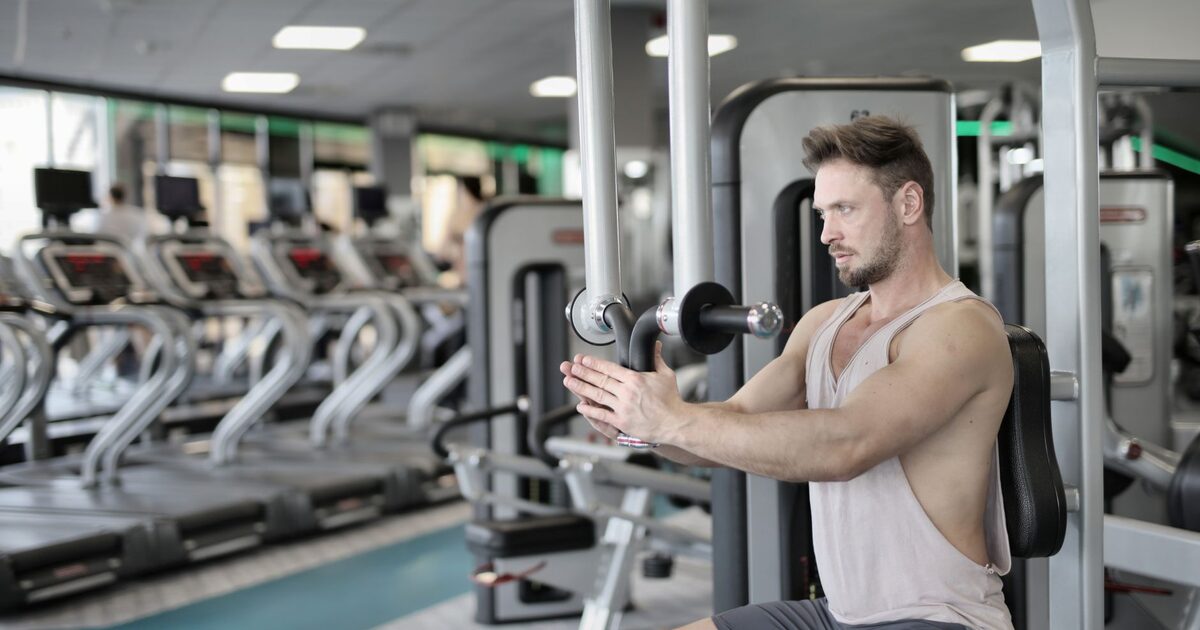
Most lifters who can't grow their chest aren't choosing the wrong exercises. They're cutting the rep short at the top, never loading the stretched position, and adding plates faster than they add muscle. Fix those three things and the movements below will do the rest. This is a ranked list, built around what actually drives chest growth, with the sets, reps, and form cues that make each one work.
What actually builds a bigger chest
Three things grow muscle, in this order of practical importance: mechanical tension through a full range of motion, enough hard sets per week, and progressive overload over months. For the pecs specifically, that means training the muscle where it's lengthened — at the bottom of a press or the stretch of a flye — not just grinding the lockout where your triceps take over.
A realistic target is 10 to 20 hard sets for the chest per week, spread across two sessions. "Hard" means you stop with 1 to 3 reps left in the tank (RIR 1–3), not 8. Mix a heavy strength range (4–6 reps) with a hypertrophy range (6–12), and add a little weight or a rep whenever you clear the top of a range with good form. That's the whole engine. The exercises just decide how efficiently you feed it.
The 6 best chest exercises, ranked
1. Barbell bench press
Still the foundation. It lets you load more absolute weight than any other chest movement, and heavy loading over time is what forces the pecs to grow. It also gives you a clean, measurable progression — the bar weight either goes up or it doesn't.
Programming: 3–4 sets of 4–6 reps, 2–3 minutes rest. Cues: pull your shoulder blades back and down and keep them pinned to the bench; touch the bar to your lower sternum, not your collarbone; drive your feet into the floor. Common mistake: flaring the elbows to 90 degrees, which hammers the shoulders. Keep them tucked to roughly 45–75 degrees from your torso. New to the bar path? The exercise library has the setup demoed from the side.
2. Incline dumbbell press
The upper chest is what gives a physique that "shelf" look, and it's the region most lifters under-train. An incline shifts emphasis there, and dumbbells let each side work independently while giving you a deeper stretch at the bottom than a barbell allows.
Programming: 3–4 sets of 6–10 reps, ~2 minutes rest. Cues: set the bench to 15–30 degrees — steeper than that and your front delts start running the show; lower until you feel a stretch across the upper pec, then press the dumbbells up and slightly together. Common mistake: using an incline so high it becomes a shoulder press.
3. Weighted dips
The best loaded stretch you can put on the lower and outer chest. Dips let the pecs work through a huge range under a load you can progressively add to with a belt, which is a rare and valuable combination.
Programming: 3 sets of 6–10 reps, adding weight once you can do 10 clean reps. Cues: lean your torso forward 15–30 degrees to bias the chest over the triceps; descend until your upper arms are roughly parallel to the floor. Common mistake: going so deep your shoulders roll forward painfully — depth should be controlled by your shoulder health, not ego. If dips bother your shoulders, swap in a decline press.
4. Machine chest press
An underrated mass builder. Because the machine handles stability for you, every bit of effort goes into the pecs, and you can push close to failure safely without a spotter — which is exactly where the last few growth-driving reps live.
Programming: 3 sets of 8–12 reps, 90 seconds rest, taking the last set to within 1 rep of failure. Cues: align the handles with mid-chest height; pause for a beat at full stretch. Common mistake: half-repping heavy weight. Pick a load you can move through the complete range.
5. Cable or dumbbell flye
Presses load the chest mostly at the bottom; cables keep tension on the pecs through the entire arc, including the squeeze at the top where dumbbells go slack. Use this as your dedicated stretch-and-contract movement, not a heavy ego lift.
Programming: 3 sets of 12–15 reps, 60–90 seconds rest. Cues: keep a soft, fixed bend in the elbows the whole set; think about hugging a barrel and feel the stretch at the bottom. Common mistake: turning it into a pressing motion by bending and straightening the arms — that's a sign the weight is too heavy.
6. Push-up (weighted or deficit)
A finisher that earns its place, especially when you add load or raise your hands on plates for a deeper stretch. It's the easiest way to chase a pump and rack up extra volume at the end of a session without taxing your joints further.
Programming: 2–3 sets to within 2 reps of failure. Cues: keep a straight line from heels to head and let the chest, not the chin, lead the way down. Common mistake: sagging hips, which turns it into a lower-back exercise.
How to put it together
You don't need all six in one workout. Pick a heavy compound press, an upper-chest movement, a loaded stretch, and one isolation, then rotate. Here's a clean chest day that hits every region and lands inside that 10–20 weekly set range when run twice a week.
| Exercise | Sets | Reps | Rest |
|---|---|---|---|
| Barbell bench press | 4 | 4–6 | 2–3 min |
| Incline dumbbell press | 3 | 6–10 | 2 min |
| Weighted dips | 3 | 6–10 | 2 min |
| Cable flye | 3 | 12–15 | 60–90 sec |
Run this twice a week with two or three days between sessions so the muscle recovers. On the second day, swap the barbell bench for the machine press and add a push-up finisher — the variation keeps the stimulus fresh and works the pecs from slightly different angles. Track your top-set weight every session; if the numbers aren't trending up over a month, that's your signal to eat more, sleep more, or pull back the volume. A training log in the FitBot Coach app makes that trend obvious at a glance.
Don't build a chest on a weak frame
A big chest on rounded shoulders and a flat back looks off and presses worse. Balance every chest session with pulling volume so your shoulders stay healthy and your posture holds up under heavy benching — start with these back exercises for a wider back. And resist the classic upper-body-only trap: your legs are half your body and skipping them leaves you front-heavy and capped on overall strength, so program these leg exercises for size and strength too.
Feed the growth
Training is the signal; food is the raw material. To add chest mass you need a slight calorie surplus and roughly 1.6 to 2.2 grams of protein per kilogram of body weight per day — about 30 to 40 grams per meal across three or four meals. Miss that and you're sending the build order without delivering the bricks. If hitting your protein target feels like a chore, these high-protein recipes take the guesswork out of it. Train hard through a full range, overload it patiently, eat enough, and the chest follows.
Key takeaways
- Train the chest through a full range and load the stretched bottom position, not just the lockout
- Aim for 10-20 hard sets per week, stopping each set 1-3 reps shy of failure
- Barbell bench, incline dumbbell press, and weighted dips are your top three mass builders
- Add cable flyes and machine presses to keep tension on the pecs and push close to failure safely
- No surplus and 1.6-2.2g protein per kg means no new muscle, no matter how hard you train
Frequently asked questions
How often should I train chest to build mass?
Twice a week works better than once for most lifters, with two or three days between sessions to recover. Splitting your 10-20 weekly sets across two days lets you train each with more quality and intensity. Hitting chest only once a week can work, but you'll usually grow faster spreading the volume.
Is barbell or dumbbell bench press better for chest growth?
Both build mass, and the best programs use both. The barbell lets you load the most absolute weight and progress cleanly, while dumbbells give a deeper stretch and let each side work independently. Lead with the barbell for strength and use dumbbells, especially on an incline, for range and balance.
Why isn't my chest growing even though I bench heavy?
Usually one of three things: you're cutting reps short of a full stretch, your weekly volume is too low, or you're not eating in a surplus with enough protein. Heavy benching alone isn't enough if the pecs never reach a lengthened position under load. Check your range of motion, push toward 10-20 hard sets a week, and confirm your nutrition supports growth.