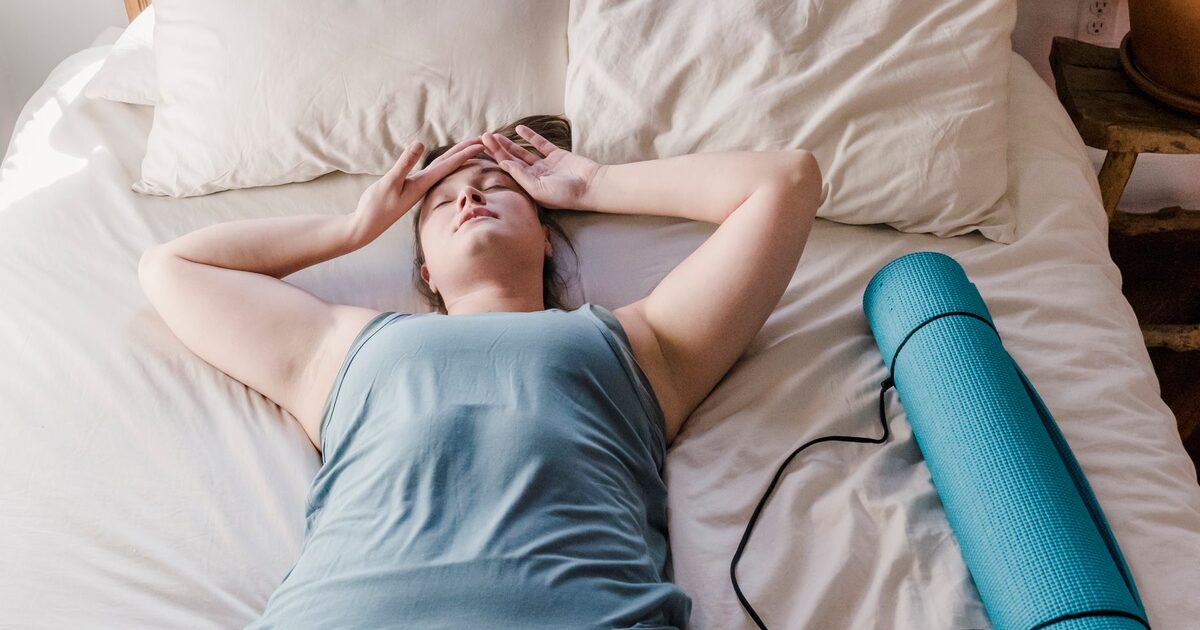
You can nail your training split and hit your protein target every single day, but if you are sleeping six hours a night, you are building muscle with the handbrake on. Sleep is where most of the actual adaptation happens. The gym is the stimulus; the night is the construction crew. Skip the night and the crew never shows up.
What your body actually does while you sleep
Muscle does not grow during your workout. Resistance training causes microscopic damage to muscle fibres and switches on the signalling pathways for repair. The repair itself, where muscle protein synthesis outpaces breakdown and the tissue comes back thicker, happens mostly during rest, and the largest single block of rest you get is overnight.
Two things drive this. First, your biggest natural pulse of growth hormone is released during deep sleep, also called slow-wave sleep. Roughly 60 to 70 percent of your daily growth hormone is secreted in the first few hours of the night, tied directly to those deep-sleep stages. Growth hormone supports tissue repair, fat metabolism, and the release of IGF-1, which is a key player in building new muscle protein. Second, sleep keeps cortisol in check. Cortisol is catabolic, meaning it breaks tissue down. Cut your sleep short and cortisol stays elevated the next day, tilting the balance away from repair.
So the night is not passive downtime. It is an active, hormonally driven repair window, and deep sleep in the first half of the night is the part that matters most for what you built in the gym.
The numbers on sleep debt and gains
The research on short sleep and body composition is unusually consistent.
In a well-known controlled study, dieters who slept 5.5 hours versus 8.5 hours lost the same total weight, but the short-sleep group lost about 60 percent more lean muscle and 55 percent less fat. Same calories, same diet. The only variable was sleep, and it flipped the result from "losing fat" to "losing muscle." If you are cutting and want to protect your hard-won mass, sleep is not optional.
A few more findings worth carrying with you:
- Testosterone drops fast. One week of sleeping five hours a night lowered daytime testosterone in healthy young men by 10 to 15 percent, the equivalent of aging 10 to 15 years.
- Strength and power dip. Sleep-deprived athletes show measurable falls in time to exhaustion, peak power, and reaction time, with the largest hits showing up in the afternoon and evening.
- Protein synthesis slows. Even a single night of partial sleep restriction has been shown to reduce the rate of muscle protein synthesis, the exact process you train to stimulate.
The pattern is hard to miss: under-sleeping keeps cortisol high, drags testosterone and growth hormone down, blunts protein synthesis, and pushes your body to burn muscle instead of fat. You can out-train almost anything except a chronic sleep deficit.
How much sleep, and which kind
For most adults who train hard, the target is 7 to 9 hours of actual sleep, not time in bed. If you scroll for 40 minutes before you drop off, you need to budget for that. An athlete training intensely sits at the upper end, and many elite programmes push for 9 to 10 hours including a daytime nap.
Quantity matters, but so does architecture. You want enough deep sleep (for the growth-hormone pulse and physical repair) and enough REM sleep (which clusters in the back half of the night and supports motor learning and mood). Cutting your night from eight hours to six does not trim evenly off both ends. It disproportionately steals from the REM-rich final hours, which is one reason a chopped-short night feels far worse than the lost hour suggests.
| Sleep duration | Likely effect on recovery and muscle |
|---|---|
| < 6 hours | Elevated cortisol, lower testosterone, reduced protein synthesis, higher muscle-loss risk on a cut |
| 6 to 7 hours | Workable short-term, but recovery and performance erode if it becomes the norm |
| 7 to 9 hours | Target range for most lifters; supports full repair and hormonal balance |
| 9 to 10 hours | Useful during heavy training blocks, illness, or hard cuts |
A practical protocol that actually works
Good sleep is a set of habits, not willpower. These are the levers with the biggest payoff, roughly in order of impact.
- Fix your wake time first, not your bedtime. A consistent wake time anchors your circadian rhythm. Hold it within about 30 minutes, weekends included. Bedtime then tends to fall into place on its own.
- Get bright light early. Ten to twenty minutes of outdoor light within an hour of waking sets your internal clock and makes you sleepy at the right time roughly 14 to 16 hours later. This single habit fixes more sleep problems than any supplement.
- Cut caffeine by early afternoon. Caffeine has a half-life of about 5 to 6 hours, so a 2 pm coffee still has a quarter of its dose circulating at 8 pm. If you are sensitive, draw the line at noon.
- Drop the room temperature. Your core temperature has to fall for deep sleep to start. A bedroom around 18 to 19 degrees Celsius (about 65 Fahrenheit) helps it happen. A warm shower 60 to 90 minutes before bed works too, because the rebound cooling afterwards nudges you toward sleep.
- Protect the last 90 minutes. Dim the lights, get off bright screens, and let your nervous system downshift. Alcohol is a particular trap here: a couple of drinks may help you fall asleep but they suppress REM and fragment the second half of the night, exactly the part you cannot afford to lose.
Train and eat in a way that protects sleep
Your training and nutrition choices feed straight back into how well you sleep, and the two reinforce each other.
Time hard sessions earlier when you can. Intense evening training spikes core temperature, heart rate, and adrenaline, which can delay sleep onset for some people. If late lifting is your only option, leave a two to three hour buffer before bed and give yourself a proper wind-down. Lower-intensity work like static stretching in the evening is a different story and can actively help you settle.
Eat enough, and put some protein before bed. Under-eating, especially low carbs late in the day, can wake you at 3 am wired and hungry. A pre-sleep dose of 30 to 40 grams of slow-digesting protein, such as casein or Greek yoghurt, supplies a steady stream of amino acids through the night and has been shown to support overnight muscle protein synthesis. If you want practical ways to hit that target without a heavy meal, our recipe library has plenty of high-protein options that sit well before bed.
Use sleep to manage soreness. Sleep is one of the most powerful recovery tools you have for next-day stiffness. If you regularly wake up wrecked, that is often as much a sleep and load-management signal as a muscle one, which we get into in our guide on why you get sore and what actually helps.
When you genuinely cannot sleep more
Sometimes life does not allow eight hours: a newborn, shift work, a brutal deadline. You are not doomed, but you do need to adjust expectations and dial in the controllables.
- Nap strategically. A 20 to 30 minute nap recovers alertness without grogginess. A full 90-minute nap completes a cycle and can recover some deep and REM sleep after a short night.
- Pull back the training load. On chronically under-slept stretches, cut volume by 20 to 30 percent rather than grinding. You will hold more strength and stay further from injury.
- Protect quality when you cannot get quantity. A dark, cool, quiet room squeezes more recovery out of every hour you do get.
Treat sleep as the third pillar of training, sitting right alongside how you lift and how you eat. You can browse the exercise library to structure smarter sessions, and if you want training, nutrition, and recovery tracked in one place, the app ties it together. But of the three, sleep is the one most people leave on the table, and it is the cheapest set of gains you will ever find.
Key takeaways
- Most muscle repair happens overnight, driven by deep-sleep growth hormone and lower cortisol.
- Sleeping 5.5 vs 8.5 hours on a diet cost dieters ~60% more muscle and 55% less fat loss.
- One week at 5 hours a night dropped young men's testosterone by 10 to 15 percent.
- Aim for 7 to 9 hours of actual sleep; fix your wake time and get bright light early.
- 30 to 40g of casein or Greek yoghurt before bed supports overnight protein synthesis.
Frequently asked questions
How many hours of sleep do I need to build muscle?
Most adults who train hard need 7 to 9 hours of actual sleep, not just time in bed. Athletes in heavy training blocks often benefit from 9 to 10 hours, sometimes including a daytime nap. Consistency matters as much as duration.
Does a protein shake before bed really help?
Yes, within reason. A 30 to 40 gram dose of slow-digesting protein like casein or Greek yoghurt supplies amino acids through the night and has been shown to support overnight muscle protein synthesis. It is a useful tool, not a substitute for hitting your total daily protein.
Can I build muscle on six hours of sleep?
You can, but you are working against yourself. Chronic short sleep raises cortisol, lowers testosterone and growth hormone, and blunts protein synthesis, which slows muscle gain and risks muscle loss during a cut. Six hours is workable short-term but a poor long-term baseline.