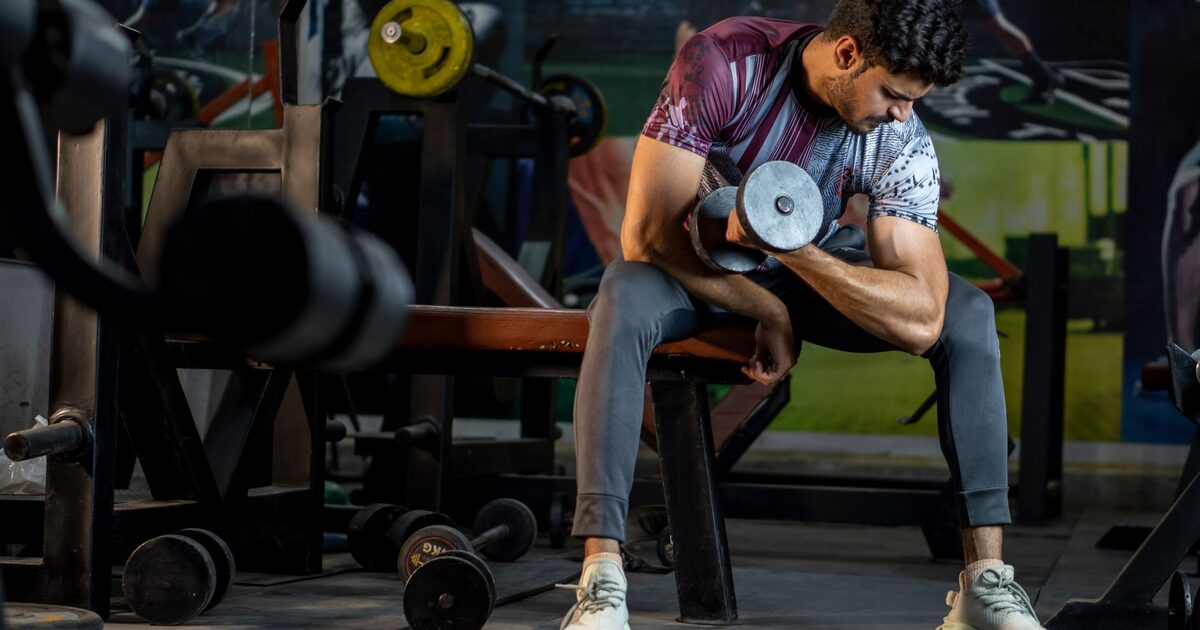
Arms are the most trained and most stubborn muscle group in any gym. People do four sets of curls, feel the pump, and wonder why nothing changes after six months. The fix is rarely "more curls." It's training the triceps hard enough, hitting the biceps from the right angles, adding weight over time, and eating enough to actually build tissue. Here is exactly how to do that.
Know what you're actually building
Your upper arm is mostly triceps. The triceps make up roughly two-thirds of upper-arm mass, split across three heads (long, lateral, medial). If your goal is sleeve-filling size, the triceps deserve at least as much attention as the biceps, usually more. Most people have it backwards.
The biceps brachii has two heads, and underneath sits the brachialis, a muscle that pushes the biceps up and visibly widens the arm from the front. You build the brachialis with neutral-grip and reverse-grip work, which is why hammer curls matter. So "bigger arms" really means three jobs: triceps for mass, biceps for the peak, brachialis for width.
Step 1: Set the weekly volume
For arms that lag, aim for 12 to 18 hard sets per muscle per week, spread across two sessions. One session a week is enough to maintain but usually too little to grow a stubborn body part. Splitting the volume, say 8 sets Monday and 8 sets Thursday, lets you train each session fresh and gives the muscle two growth stimuli instead of one.
"Hard sets" is the key phrase. A set taken to within 1 to 3 reps of failure counts. A set you stop at a random number with five reps left in the tank does not. If you can comfortably hold a conversation through your last rep, the set was a warm-up.
Most people get plenty of arm work indirectly. Rows and pulldowns hammer the biceps; presses and dips hammer the triceps. Count roughly half of that indirect work toward your weekly total so you don't bury yourself in junk volume.
Step 2: Pick exercises that cover every angle
The shoulder position changes which head of the arm does the most work, so vary it deliberately. Browse the full exercise library for demos, but this core rotation covers everything:
- Triceps, overhead (long head stretched): overhead cable extension or a seated EZ-bar extension. The long head only fully lengthens when your arm is overhead, and muscles grow well when trained in a stretched position.
- Triceps, arms-at-side (lateral head): rope or straight-bar pushdowns, and dips. These let you load heavy and chase the horseshoe look.
- Biceps, arm in front (long head, the peak): incline dumbbell curls with your arms hanging slightly behind your torso. This is the most under-used biceps movement and the best for height.
- Biceps and brachialis (width): hammer curls and EZ-bar curls. Neutral and slightly pronated grips load the brachialis and brachioradialis.
Two triceps movements and two biceps movements per session, rotating the angle each time, hits all the relevant heads inside a normal hour.
Step 3: Use rep ranges that build size
Anything from 6 to 20 reps builds muscle as long as the sets are taken close to failure. For arms specifically, a useful split is heavier compounds (close-grip bench, weighted dips, chin-ups) in the 6 to 10 range, and isolation curls and extensions in the 10 to 15 range. Smaller muscles tend to respond well to a little more time under tension, and lighter loads spare your elbow joints from the beating that heavy direct arm work can cause.
| Movement | Sets x Reps | Primary target |
|---|---|---|
| Close-grip bench or weighted dip | 3 x 6-8 | Triceps (mass) |
| Overhead cable extension | 3 x 10-12 | Triceps long head |
| Chin-up or EZ-bar curl | 3 x 6-10 | Biceps |
| Incline dumbbell curl | 3 x 10-12 | Biceps long head (peak) |
| Hammer curl | 2 x 12-15 | Brachialis (width) |
Step 4: Nail the form cues that actually matter
Arm exercises are short-range and easy to cheat, so technique decides whether the muscle or momentum does the work.
- Curls: keep your elbows pinned to your sides and slightly in front of your ribs. If your elbows drift forward as you lift, your front delts are stealing the rep. Lower over a 2-to-3-second count and do not swing the weight up with your back.
- Pushdowns and extensions: let your forearm stretch fully at the top of each rep, then drive to a hard lockout and squeeze for a beat. The lockout is where the triceps contract hardest.
- The stretch matters most: the bottom of an incline curl and the overhead position of a triceps extension are where you should feel the deepest stretch. Control that part of the rep instead of bouncing out of it.
- Wrist position: keep wrists neutral, not bent back. A cocked-back wrist shifts load to the forearm and the elbow.
Step 5: Add load every week (progressive overload)
Muscle grows when you demand more of it over time. Log every set, and each week try to add a rep or a small amount of weight to at least one set per exercise. When you hit the top of a rep range with good form, for example 3 sets of 12 on incline curls, add 2 to 2.5 kg and drop back to the bottom of the range. This slow, tracked climb is what separates people who grow from people who lift the same dumbbells for years. How muscles actually grow covers the repair process that makes this work.
Step 6: Recover and eat for growth
Arms are small and recover fast, but they still need a rough 48 hours between hard sessions, which is exactly why the two-day-a-week split works. Train them Monday and Thursday, not on back-to-back days.
Tissue needs raw material. To gain size, eat in a slight calorie surplus of roughly 200 to 300 calories above maintenance, and get 1.6 to 2.2 grams of protein per kilogram of bodyweight each day. For an 80 kg lifter that's about 130 to 175 grams of protein. Spread it across three or four meals so you're feeding muscle throughout the day. If hitting those numbers is hard, our high-protein recipes make it easier. Sleep is non-negotiable too; aim for 7 to 9 hours, since most muscle repair happens overnight.
Total-body tension drives growth everywhere, not just the arms. If you train the principles in this guide across other lagging areas, the same rules apply, as our guide to building bigger glutes shows.
A simple 8-week plan
Run the table above twice a week for eight weeks. Keep a training log, add load whenever a set feels easy, and take progress photos every two weeks rather than staring in the mirror daily. Want the whole thing built, tracked, and adjusted for you? Get the app and let FitBot Coach program your arm days, count your sets, and tell you exactly when to add weight.
Bigger arms are not complicated. Train the triceps as hard as the biceps, cover every angle, take sets close to failure, add a little weight every week, and eat enough to grow. Do that for two months and your sleeves will tell you it's working.
Key takeaways
- Triceps are two-thirds of your arm, so train them at least as hard as biceps
- Aim for 12-18 hard sets per muscle per week, split across two sessions 48+ hours apart
- Cover every angle: overhead extensions for the long head, incline curls for the biceps peak, hammer curls for width
- Take sets to within 1-3 reps of failure and add a rep or 2-2.5 kg each week
- Eat 1.6-2.2 g protein per kg bodyweight in a slight calorie surplus and sleep 7-9 hours
Frequently asked questions
How long does it take to see bigger arms?
With consistent training and enough food, most people notice a visible change in 8 to 12 weeks. Newer lifters gain faster because untrained muscle responds quickly. Track sets and progress photos rather than judging by daily mirror checks.
Should I train biceps and triceps on the same day?
Yes, that works well and is efficient. Pairing them in one session lets you superset opposing muscles and keeps each fresh. Just make sure you get roughly 48 hours before training arms hard again.
Are curls enough to build big arms?
No. Curls only train the biceps and brachialis, which are the smaller part of your arm. The triceps make up about two-thirds of upper-arm mass, so skipping direct triceps work leaves most of your potential size on the table.