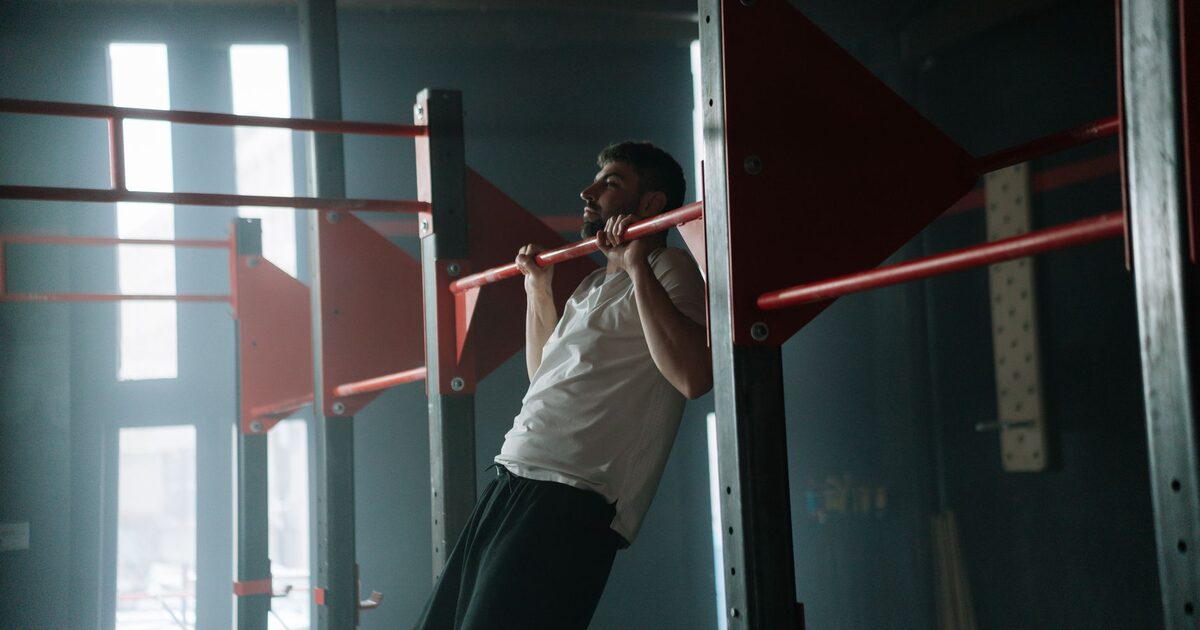
The pull-up is one of the few exercises where you either can or you can't, and the jump from zero to one feels impossibly large from below. It isn't. Your first rep is a strength problem with a clear solution: build the right muscles in the right positions, in an order your body can actually adapt to. This guide lays out that order, the numbers to aim for at each stage, and the form details that decide whether your hard work shows up on the bar.
What a pull-up actually demands
A strict pull-up asks you to move your full bodyweight through a long range while keeping your shoulders, core, and grip working together. The prime movers are your lats and the muscles around your shoulder blades, with heavy help from your biceps and forearms. The reason most people stall is not weak arms, it's a weak link somewhere in that chain, usually the lats or the scapular muscles that should set your shoulders before the arms ever bend.
That matters for how you train. You can't out-curl a missing pull-up; you have to load the whole pattern. The fastest route is to practise positions that look like the top, middle, and bottom of the rep, then gradually take away the assistance until you're hanging on your own.
Build the base: three movements before you chase the bar
Before assisted reps make sense, you want a foundation in these three. Train them twice a week and most beginners hit the numbers below in four to eight weeks.
- Dead hang. Grab the bar, hands just outside shoulder width, and simply hang with arms straight. This builds grip and conditions your shoulders to support load. Goal: one hang of 30 seconds.
- Scapular pull-up. From a dead hang with straight arms, pull your shoulder blades down and back so your chest rises a few centimetres, then lower under control. No elbow bend. This teaches the position that starts every real rep. Goal: 3 sets of 8 clean reps.
- Inverted row. Set a bar at hip height in a rack (or use rings), hang underneath with a straight body, and pull your chest to the bar. The flatter your body, the harder it is. Goal: 3 sets of 10 to 12 with your torso below parallel.
Don't skip the hang. Grip is the quiet reason many people fail their first attempt: the back is ready but the hands give out. If you want a structured push pattern to balance all this pulling, our push-up variations slot in on alternate days.
The progression ladder
Once the base is in place, work through these in order. Move to the next rung only when you can hit the target with clean form, and keep the easier variations in rotation as warm-ups.
| Stage | What to do | Move on when you can |
|---|---|---|
| 1. Negatives | Jump or step to the top position, chin over the bar, then lower as slowly as you can | Control a 5-second descent for 3 sets of 5 |
| 2. Band-assisted | Loop a resistance band over the bar and under your knees or feet; the band helps most at the bottom | Do 3 sets of 8 with a light band |
| 3. Partial pulls | From a dead hang, pull as high as you can, even if it's only halfway, building toward chin height | Pull your eyes to bar level unassisted |
| 4. First full rep | Dead hang, set the shoulder blades, pull until your chin clears the bar | You did it. Now build to 3 reps, then 5 |
Negatives are the highest-value step here, because you're often 40 percent stronger lowering a weight than lifting it. That lowering strength carries directly into your first pull. A useful rule: if you can already control a slow 5-second negative, your first clean rep is usually weeks away, not months.
How to use a band without leaning on it
Bands are excellent, but they flatter you at the bottom and offer almost nothing at the top, the exact spot most people struggle. Pick the lightest band that lets you finish a set, not the thickest one in the rack. As soon as a band feels easy for 8 reps, drop to a lighter one. Treat the band as a dial you keep turning down, not a permanent crutch.
Form cues that decide the rep
Good positions make a hard rep possible and keep your shoulders healthy. Drill these from your very first negative:
- Start packed. Before you bend your elbows, pull your shoulder blades down and together. Shrugging up into your ears is the most common fault and shuts your lats off.
- Drive the elbows down. Think about pulling your elbows toward your hip pockets and into your sides rather than "pulling yourself up". It cues the lats correctly.
- Lead with the chest. Aim your collarbone at the bar and finish with your chin clearly over it. A half rep that stops at the eyes doesn't count as your first.
- Stay tight, no kipping. Squeeze your glutes and brace your midsection so you don't swing. A slight cross of the ankles behind you helps. Save kipping for later; right now you want strict reps.
- Control the bottom. Lower until your arms are straight and your shoulders are set, without collapsing into a loose, dangling hang. Full range builds the strength a half rep never will.
Programming: how often and how hard
Pull-up strength responds to frequent, high-quality practice more than to occasional all-out sessions. Train the pattern 2 to 3 times a week, leaving at least a day between sessions so your elbows and shoulders recover. Keep every rep clean: 3 quality reps beat 6 sloppy ones for building the strict strength you're after.
A simple weekly setup that works:
- Day A: Your hardest current stage (negatives or band reps) for 3 to 4 sets, then scapular pulls and dead hangs.
- Day B: Inverted rows for volume, 3 to 4 sets, plus one set of your hardest stage to keep grooving it.
Stop each set 1 to 2 reps shy of total failure. Grinding to a complete stop wrecks your form and your grip for the next set without adding much. Balance the pulling with pressing and lower-body work so you don't build a one-sided body; if you need a lower-body anchor for those days, our guide to lunges covers the basics.
Bodyweight, fuel, and patience
Two things you can't cue your way around. First, the lighter you are, the less you have to pull, so if fat loss is a goal, even a few kilograms makes the bar noticeably easier; eating with that in mind helps, and our recipes make a protein-forward diet less of a chore. Second, tendons in the elbows and shoulders adapt slower than muscle, so resist the urge to train the pattern daily. Soreness in the front of the elbow is your signal to back off the volume for a few days.
Expect the timeline to vary. A lighter, already-active beginner might earn a first rep in six to eight weeks; someone starting heavier or detrained may need three to six months. Both are normal. The progression is the same; only the pace differs. Keep your stages, reps, and rest in one place; a simple training log is enough to show when you've earned the next rung.
The short version
Build a 30-second hang and solid inverted rows, then climb the ladder: negatives, then bands, then partials, then your first strict rep. Keep every rep clean, train the pattern two or three times a week, and let your tendons catch up. The day your chin clears the bar on its own, you'll wonder why it ever felt out of reach.
Key takeaways
- Build a base first: a 30-second dead hang, clean scapular pulls, and inverted rows below parallel.
- Climb the ladder in order: negatives, then band-assisted reps, then partial pulls, then your first full rep.
- Slow 5-second negatives are the highest-value step; lowering strength carries straight into your first pull.
- Set your shoulder blades down and back before bending your elbows, and finish with your chin clearly over the bar.
- Train the pattern 2-3 times a week, stop 1-2 reps shy of failure, and let your tendons recover.
Frequently asked questions
How long does it take to do your first pull-up?
It depends on your starting weight and training history. A lighter, already-active beginner might earn a first rep in six to eight weeks, while someone heavier or detrained may need three to six months. The progression is identical; only the pace differs.
Are band-assisted pull-ups or negatives better for beginners?
Both help, but negatives tend to build strict strength faster because you can control your full bodyweight on the way down. Bands assist most at the bottom and least at the top, where people struggle most. Use negatives as your main driver and bands to add clean volume, picking the lightest band that lets you finish a set.
Why can't I do a pull-up even though my arms feel strong?
A pull-up is usually limited by your lats, the muscles around your shoulder blades, or your grip, not your biceps. If your back doesn't set before your arms pull, or your hands give out on the bar, the rep fails regardless of arm strength. Train scapular pulls, inverted rows, and dead hangs to fix the weak link.